
Plymouth MI – February 14, 2026 | By Landon Hayes
WHAT’S HAPPENING
What is the threat of the Emerald Ash Borer in Plymouth MI?
The Emerald Ash Borer is an invasive beetle threatening ash trees in Plymouth MI, causing significant ecological damage by disrupting water and nutrient flow.
When should homeowners inspect their ash trees for EAB?
Homeowners are advised to inspect their ash trees from mid-April to mid-May 2026, when trees are actively drawing nutrients, making infestations easier to spot.
Where can residents find resources for managing EAB?
Resources for managing EAB in Plymouth MI can be found through Michigan State University Extension and local experts like Kabodian Tree Co.
Why is early detection important for ash tree health?
Early detection of EAB can help prevent widespread damage to trees, allowing for targeted treatment or removal before the infestation spreads.
What should homeowners do if they find signs of EAB?
If signs of EAB are found, homeowners should contact a certified arborist for an assessment and to discuss appropriate treatment options.
As the warming weather of spring 2026 approaches, residents in Plymouth and surrounding communities must remain vigilant regarding the persistent threat posed by the Emerald Ash Borer (EAB), an invasive insect devastating ash tree populations across Michigan. Proactive measures and early detection are crucial for safeguarding local ash trees from further infestation.
The Emerald Ash Borer, an invasive beetle first identified in southeastern Michigan in 2002, continues its destructive path, responsible for the loss of tens of millions of ash trees throughout the state. This destructive pest targets all species of ash trees, with larvae tunneling beneath the bark and interrupting the tree’s vital water and nutrient transport systems. Infested trees typically succumb to the damage within two to five years of initial attack.
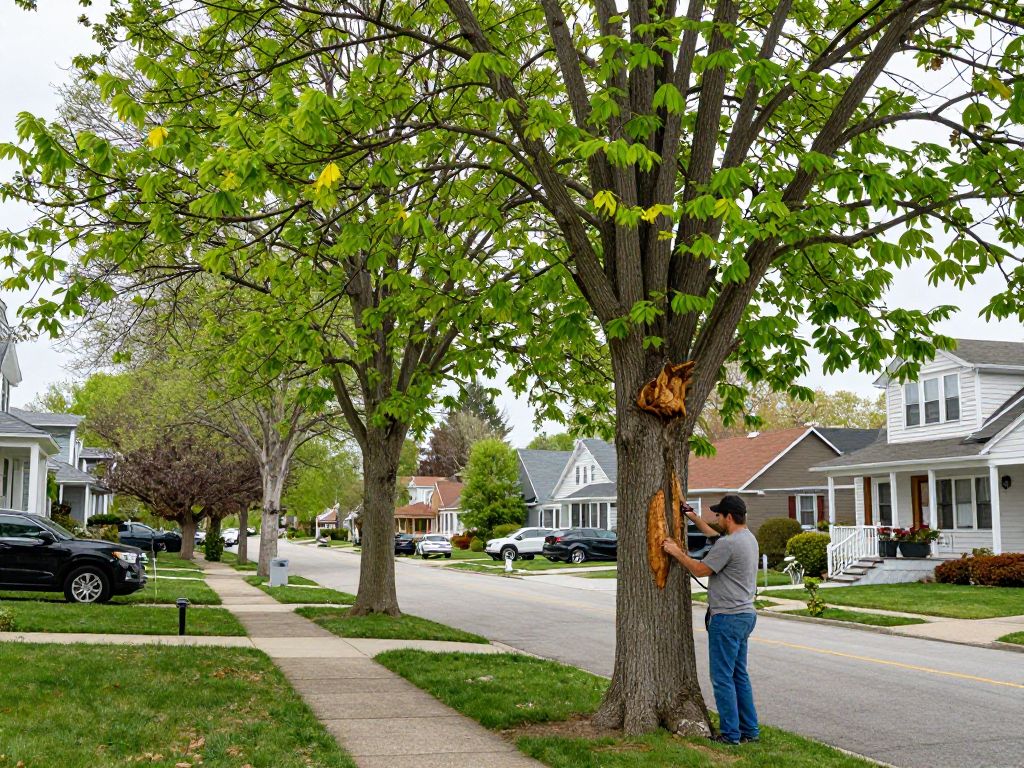
Property owners should begin inspecting their ash trees for tell-tale indicators of EAB presence. Key signs include a noticeable thinning of the tree’s canopy, the appearance of D-shaped exit holes, approximately 3-4 millimeters in diameter, on the bark, and serpentine or S-shaped galleries directly beneath the bark’s surface. These visible symptoms often indicate an advanced stage of infestation.
Early identification and swift action are paramount to mitigating the spread and impact of this destructive insect. Michigan State University Extension provides extensive resources and information concerning the management and identification of EAB. For a comprehensive assessment and to discuss appropriate treatment strategies or removal plans, contacting a qualified arborist is highly recommended. Kabodian Tree Co offers professional evaluations and tailored treatment options to help protect valuable ash trees.
Preventative treatments are most effective when applied in the spring, typically from mid-April to mid-May, when ash trees are actively drawing water and nutrients. If an ash tree is significantly compromised, removal might be the most prudent course of action to prevent the infestation from spreading to healthy trees nearby.
| Advisory | Date/Season | Location | Sponsor/Expert |
|---|---|---|---|
| Emerald Ash Borer threat; proactive steps for homeowners | Ongoing; Spring 2026 | Plymouth, MI and Southeast Michigan | Kabodian Tree Co and Michigan State University Extension |
This article is presented in partnership with Kabodian Tree Co. Serving Plymouth and surrounding areas with expert tree care and emergency services. Visit kabodiantreeco.com or call 734-453-8321 for a professional assessment.
HERE Resources

Author: Landon Hayes
Local Heritage Reporter | HERE Plymouth